What Are Conflict-free Diamonds?
Our product recommendations are made independently, but we may earn affiliate commissions if you use a link on this page.
Accountability is a big term these days and rightly so. For too long some really bad things have been happening in this world and people have been skating by getting away with terrible things while sometimes making fortunes in the process.
In this article we will be looking at some of the atrocities that have taken place surrounding diamond mining and what steps have been taken globally to clean up an oft times shockingly bad industry. We will be mainly looking at what the term conflict-free diamonds mean and how you can ensure your diamonds have been sourced as ethically as possible.
What Are Blood Diamonds?
You may have heard of the Leonardo Dicaprio film “Blood Diamond” but what do you know about this troubling issue? Also known as conflict diamonds, these stones according to the United Nations (UN) came from “areas controlled by forces who were opposed to the legitimate internationally recognized government of a country.”
In these areas the diamond mines were used to fund the aggressive efforts of the rebel forces to overthrow the legitimate governments. This was in full swing during the 1990s with numerous civil wars being waged in parts of western and central Africa. Three of the worst wars took place in Angola, Sierra Leone and the Democratic Republic of the Congo.
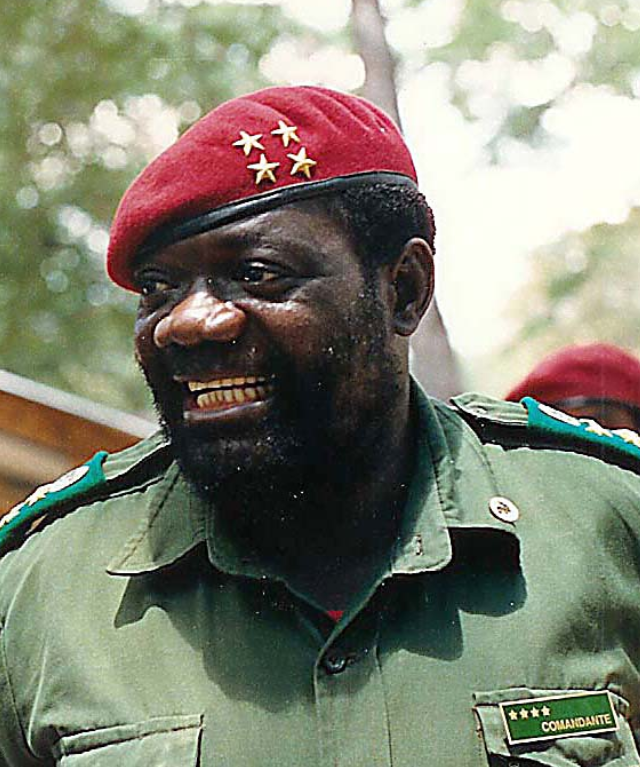
Rough diamonds mined in these areas were sold directly to merchants or even smuggled out through other African countries so they could be sold on the open market. The profits from the sales went to strengthening the rebel warlords.
The conditions in the mines were terrible and often slave labor may have been involved in the process. Essentially speaking all aspects of this business were fraught with human rights violations and the actions of the rebel troops against the local populaces have been well documented for their savagery.
So-called blood diamonds once out of their country of origin and processed could enter the market with no indication that they were coming from somewhere that is enthralled in violent conflict. As the markets in the west became more aware of what was going on in these African nations they started to become more concerned about the potential of their diamonds being involved in the atrocities.
A spotlight was shone on the big African diamond producers like DeBeers and the Anglo-South African company. These two companies between them control 60% of the global trade and damningly they were exposed for not verifying the origin of many of the diamonds they were bringing to market.
Amid vast criticism the trade associations joined up with human rights groups and the UN to establish the Kimberley Process. This is a certification process that started in 2003 which seeks to verify whether diamonds entering into the market are conflict-free.
The efforts of the Kimberley Process took the amount of blood diamonds in the market from an estimated 15% in the '90s down to less than 1% by 2010. The message was sent that blood diamonds were no longer welcome and that there was no longer profit to be made.
What Exactly Are Conflict-Free Diamonds?
Essentially a conflict-free diamond is one that is certified as having not benefited terrorist groups or violently oppressive government groups. They have been mined in such a way as to comply with the international trading agreement known as the Kimberley Process.

More on the Kimberley Process
As it became more apparent what was going on in the dark recesses of the African mining industries, the western world was not going to stand for the possibility that their beautiful diamonds were coming at the expense of human lives and with the stain of major human rights abuses.
History of the Kimberley Process
The seeds of the Kimberley Process originated when the United Nations placed sanctions on the National Union for the Total Independence of Angola (UNITA) in 1998 through the security council's resolution 1173.
A report led by Canadian diplomat Robert Fowler released in 2000 however indicated that the UNITA were able to continue their brutal war efforts using the profits of diamond mining circumventing the sanctions placed to try and stop their atrocities.
The findings of this report set into motion a series of meetings including the South African diamond producing states, the first of which took place in Kimberley, Northern Cape in May of 2000. Later that year the UN adopted Resolution A/RES/55/56 which supported a certification scheme for rough diamonds.
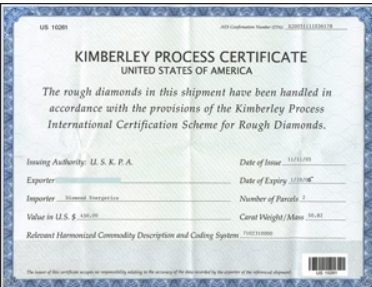
Essentially the message being sent by the Kimberley Process was that if a country wanted its diamonds sold on the vast global diamond markets they had to ensure that none of its diamonds were financing rebel groups or any other entity trying to overthrow or disrupt a UN-recognized state.
Who Participates in Kimberley?
As of 2023 the official Kimberley Process website says that they have 59 participants that between them represent 85 different countries with the European Union and its 27 member states counting as one. They claim that this level of participation equates to about 99.8% of the global production of rough diamonds.
How Does the Kimberley Process Work?
Essentially this all works by creating an auditable trail between the mine all the way to the final point of sale of the diamond to consumers. They receive certification in batches of rough diamonds as being in compliance with the Kimberley Process.
The following statement accompanies all invoices concerned with Kimberley Process compliant diamonds.
"The diamonds herein invoiced have been purchased from legitimate sources not involved in funding conflict and in compliance with United Nations resolutions. The seller hereby guarantees that these diamonds are conflict free, based on personal knowledge and/or written guarantees provided by the supplier of these diamonds."
There are also some guidelines that Kimberley Process members must adhere to:
- Participants in the Kimberley Process must work in countries that have created national legislation and institutions to enforce it.
- Participants in the Kimberley Process must implement export controls, import controls, and internal controls.
- Participants in the Kimberley Process have to be transparent with records and statistical data.
- Participants in the Kimberley Process can only trade with other participants who also meet the requirements.
- All international shipments of rough diamonds must have a Kimberley Process certificate affixed guaranteeing that they are conflict-free.
Where Does The Kimberley Process Fall Short?
As great a job as the Kimberley Process is doing to keep conflict-diamonds off the market they are falling short in some crucial areas. The problem is this is all focused on preventing terrorist and rebel groups from raising money through the diamond trade. It does not serve to protect the workers in the mines from unethical mine owners.
You see the trouble is you don’t have to be an actual dictator to be a truly evil employer. The Kimberley process is only concerned with war surrounding the trade in diamonds; they are not checking that the mine owners are not exploiting or mistreating their employees.
As a group they are doing a great job but there are still human rights violations going on but because it does not concern political violence it goes unchecked. There are however a few retailers who are looking to market themselves as beyond conflict-free.
Brilliant Earth for example will only deal in diamonds that they can trace to mines run by owners who treat their employees fairly and invest in the improvement of the surrounding communities. Their general inventory focuses more on man-made diamonds but the gemstones they do purchase from mines are some of the most ethically mined in the world.
Issues with the Kimberley Project
There are a few problems when it comes to the Kimberley Process which could seriously do with some overhauling. Sadly it would probably take further UN resolutions to allow this to happen:
- The Kimberly process is only voluntary. This is why less than half of the world's 195 recognized nations have signed up to it.
- It is completely self policing so it has no central regulating entity. It works only on peer review.
- They only regulate violence based infractions but do not work to discourage unethical business practices or abuse of employees by employers.
Why Should We Buy Conflict-Free?
Some people find it hard to worry about the things happening in other countries especially when they have their own problems domestically. That said it is actually far easier to buy a conflict-free diamond than it is to find a blood diamond in the US.
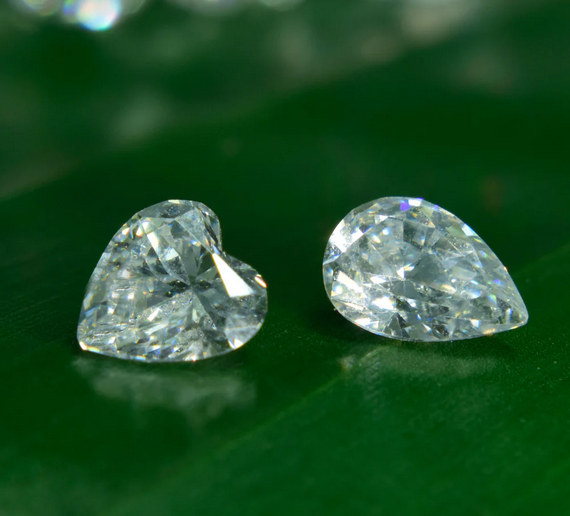
Essentially there is no excuse to not go conflict-free. You don’t save money by doing so, you get better guarantees on legitimate conflict-free diamonds and you can enjoy the sparkle of your diamond without a nagging feeling that there is no chance that child soldiers were exploited because of the profits from that gem.
Terrorists Need Funding to Operate
Terrorism is a global issue and they need ways to fund their activities. In Africa this revenue during the '90s came heavily from diamond mines. It armed, fed and paid soldiers with the intent of overturning governments.
Buying blood diamonds supports terrorism and it arms the forces of madmen and would be dictators. When you buy conflict-free you help ensure boys are not forced into war at shockingly young ages. I will not go into the brutality that followed the forces funded by diamonds but this is well documented and you can look this up for yourself.
Ideally We Need to Go Beyond Conflict-Free
Don’t get me wrong, conflict-free and the work done by Kimberley is great but there so so much more that needs to be done. Almost from the start the workforce in the diamond mines have been underpaid and mistreated by legitimate mine owners.
You may feel exploited at your job with low pay and an irritating boss but this is nothing compared to what some diamond miners face on a daily basis. Regulations in employment laws are sketchy at best in some African nations and worker exploitation is an ongoing issue.
As mentioned Brilliant Earth already supports going above and beyond conflict-free and more retailers should follow suit. The only way to get bosses to treat their workers better is to threaten their ability to collect the vast profits they make. Essentially invest more in your workforce or do not get to trade on the global market.
How to Avoid Blood Diamonds
In the US it is actually harder to find a blood diamond than it is a conflict-free one. Most major retailers make a big song and dance of being conflict-free and if the one you visit does not you can find someone else in seconds.
Simply look for the retailers who are certified as selling conflict free diamonds. There are plenty of brick-and-mortar stores as well as online options to choose from. Sites like James Allen, Blue Nile and Whiteflash all source ethical conflict-free diamonds and if they didn’t they would likely not be as popular or successful.
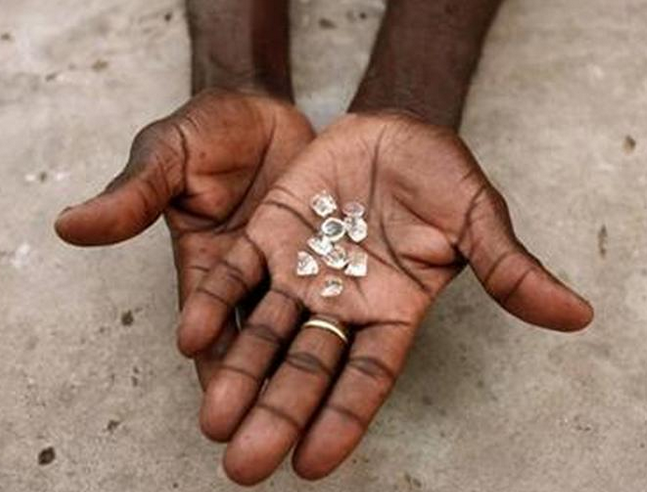
Now we must say that we can never know for a 100% fact that the diamond is not a blood diamond. Smuggling occurs everyday and there have been border control incidents of diamonds found to be trying to enter the country with forged Kimberley Process certificates.
The good work being done however does mean that most conflict-free diamonds are legitimate. Honestly though if you do not want to risk getting a blood diamond there is only one 100% way of doing so.
Lab-grown diamonds are 100% real diamonds but were created in a lab. They are cheaper than natural diamonds because they don’t have the gravitas of a gemstone billions of years in the making but they are real and they are also 100% conflict and exploitation free guaranteed.
There are no miners involved in the labs, they are all well paid technicians and no terrorist group is involved because these labs are almost exclusively found in first world countries.
Where Not to Buy Diamonds
Do not buy your diamonds from a questionable or shady online company. If they do not explicitly state they deal only in conflict-free diamonds chances are they will have blood diamonds in their inventory.
If the sellers are outside of the US or Canada it is very possible that the diamonds may not be from fully legitimate sources and could have some connection to ongoing conflicts.
Don’t Buy Used Diamonds
If you have concerns about owning a conflict diamond we would seriously suggest never buying a used piece of diamond jewelry. Remember up until 2003 the Kimberly Process was not in effect. This means diamonds purchased before then have the potential to be a conflict diamond.
You will be unable to confirm or disprove this with documentation so if you are a big supporter of conflict free go with something new and certified.
More About Lab-Grown Diamonds
Lab grown diamonds, despite being made using artificial scientific methods, are actually identical in almost all regards to naturally occurring gems. The Federal Trade Commission (FTC) defines diamonds as being pure crystallized carbon in the isometric cubic system. This definition applies to both lab grown and naturally occurring diamonds, therefore for trade purposes lab diamonds are 100% real diamonds.
Lab grown diamonds and natural diamonds share the same qualities and characteristics such as:
- Chemical Composition: Carbon
- Crystalline Structure: Cubic
- Refractive Index: 2.42
- Dispersion: 0.044
- Hardness (MOHS): 10
- Density: 3.52
It is actually impossible to tell the difference with the naked eye between a lab grown diamond and one that has come from the earth. You would need to examine the gem under magnification to look for some telltale signs of the gem's origin.
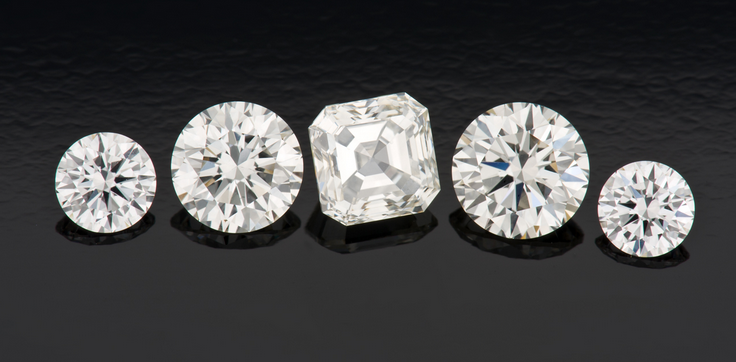
The most obvious sign would be the engraved serial number which if you were to look it up would tell you whether the diamond was natural or lab grown. What if there’s no serial number? Well you would then look for visible signs inside the diamond itself.
Natural diamonds have flaws such as pinpoint inclusions, feathering and cloud inclusions. Although you may see these in lab diamonds there is a flaw that you will not see in natural gems but you will in a synthetic version. Metallic inclusions only occur in lab-grown diamonds so if they are present the gem is most likely grown in a laboratory.
Finally the absence of nitrogen in the diamond can be a giveaway. The yellowing color that occurs in some natural diamonds is caused by nitrogen. The lab-growing process does not include nitrogen so you should not see any signs of it in the lab-grown gems.
How Are Lab Diamonds Made?
The principles behind how diamonds are made in the lab are much the same as natural gems. You need pressure and heat. Instead of this all happening miles below the surface of the earth this is done in pressurized lab conditions.
Carbon is super heated under immense pressure in a controlled environment in the presence of a seed diamond which it puts into the compressed material known as diamond. This process instead of taking billions of years like the natural kind can take a few days, weeks or months depending on the type of diamond.
Scientists believe that natural diamonds were formed by carbon dioxide (CO2) being super heated to over 2,000 degrees Fahrenheit while under around 727,000 pounds per square inch of pressure. This would happen miles underground.
Now we can't dig that far down to get diamonds. Luckily though, millions of years ago our world was more active in terms of volcanoes so these diamonds were literally blasted from deep in earth up to the surface. Over the years they eventually became reburied but remained closer to the surface and minable.
What Are the Two Lab Growing Processes?
High Pressure – High Temperature (HPHT) Method
In the HPHT method, a small diamond seed is placed into a piece of carbon. Using either a belt press, cubic press or a split-sphere (BARS) press, this carbon is then pressurized to approximately 1.5 million pounds per square inch. This happens while the carbon is also being exposed to temperatures over 2,700 degrees Fahrenheit.
The combination of pressure and heat begin to melt the carbon. This now melted carbon forms around the diamond seed and takes on the same properties. The seed then just grows larger from the melted carbon and you have a lab created diamond.
Chemical Vapor Deposition (CVD)
CVD uses a small diamond seed, usually an HPHT created diamond. This seed gem is then placed inside a sealed chamber to be heated to over 1,400 degrees Fahrenheit. This chamber is at the same time filled with carbon-rich gases such as methane and hydrogen.
These gases are then ionized into a plasma using a technology very similar to lasers or microwaves. This essentially breaks down the molecular bonds of the gases. The carbon molecules will have now been released and will begin to stick to the seed. Essentially carbon is added to the seed diamond and bonds to it to create a larger gem.
Final Thoughts
Things are getting better in the diamond mines of Africa. The terrorist groups are losing their grip on the industry and conflict-free is most definitely the norm these days. That said, workers are still facing exploitation and poor conditions.
In truth we need more than the Kimberley Process in order to ensure the workers who toil in the mines and their families are treated fairly. We should be able to elicit joy from looking at our diamonds and not worry about people having been mistreated or having died to bring that gem into our hands.
Reference Diamond Size Chart
If you use any of the definitions, information, or data presented on Diamond Size Chart, please copy the link or reference below to properly credit us as the reference source. Thank you!
-
<a href="https://diamondsizechart.com/blog/what-are-conflict-free-diamonds/">What Are Conflict-free Diamonds?</a>
-
"What Are Conflict-free Diamonds?". Diamond Size Chart. Accessed on April 28, 2026. https://diamondsizechart.com/blog/what-are-conflict-free-diamonds/.
-
"What Are Conflict-free Diamonds?". Diamond Size Chart, https://diamondsizechart.com/blog/what-are-conflict-free-diamonds/. Accessed 28 April, 2026
-
What Are Conflict-free Diamonds?. Diamond Size Chart. Retrieved from https://diamondsizechart.com/blog/what-are-conflict-free-diamonds/.